


Projection Mapping Auto Calibration and Maintenance
Projection Mapping Auto Calibration and Maintenance
In a permanent installation, even small changes in projector position can throw off an otherwise seamless image. Projection mapping auto calibration helps maintain alignment as heat, vibration and other environmental factors affect the setup over time.
We build long-running systems to stay aligned, with calibration designed into the install and support after opening night. If you are planning one, tell us about the installation and how long it will run.
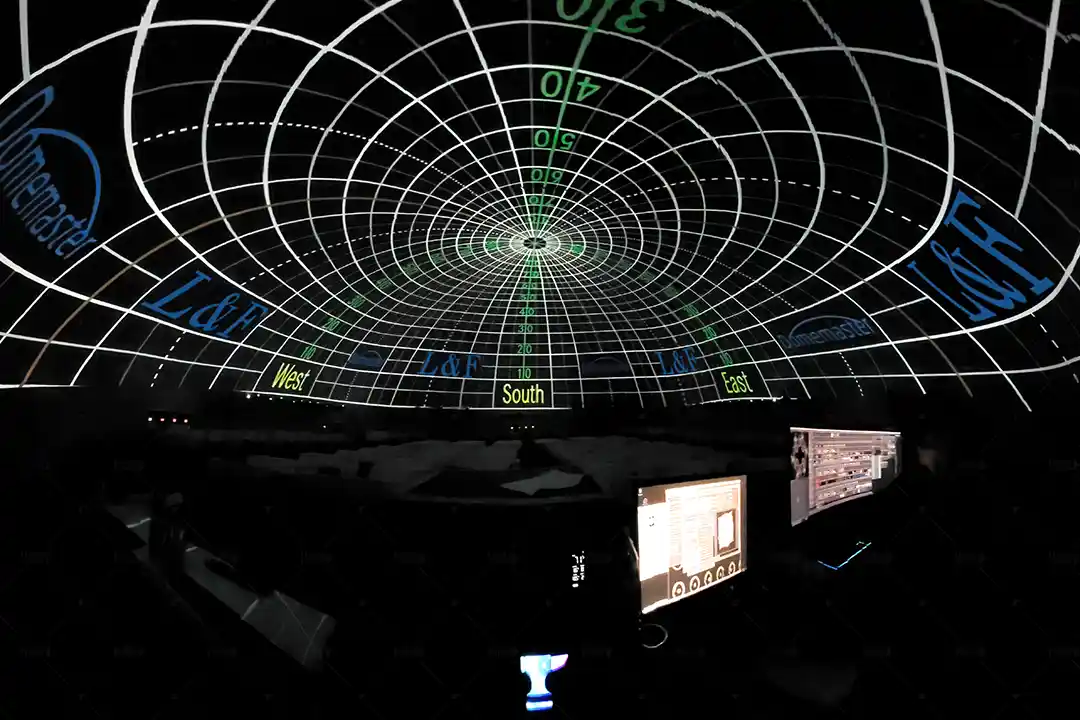
How projection mapping auto calibration keeps a show aligned
Projection mapping auto calibration ensures long term accuracy and consistent visual alignment, even as environmental conditions shift. It is especially valuable for permanent and semi-permanent installations, where vibration, thermal drift, routine maintenance or minor structural movement can affect projector positioning.
For long-term installations, we employ camera-based auto-alignment that continuously adjusts brightness and color so the system stays locked in. It corrects drift without constant manual recalibration, which is what turns a one-time event into a reliable, long-term installation.
The system is only as good as the model behind it. Auto-alignment systems and media servers solve faster and more accurately when their internal model matches reality, so we position the hardware, run auto-alignment where appropriate and finish with manual mesh tweaks.
What we take care of
- Calibration built into the system. By integrating automated calibration workflows directly into the system, we reduce manual labor, accelerate resets and maintain a consistently precise presentation.
- Scheduled calibration. We calibrate systems on a regular schedule, including white point, color balance and gamma, so a white from one unit matches a white from the next.
- Checks before doors. A daily verification pass before doors, with a quick alignment and edge check, focus confirmation and blend validation, catches drift or configuration changes early so the show opens in a known-good state.
- On-site alignment and operator support. We handle the full pipeline, from media server programming and color calibration to on-site alignment and operator support.
- Ongoing tech support. Our tech support plans are monthly, with included hours and response times that vary by tier, and an Enterprise option with dedicated engineers, custom SLAs and 24/7 support. The tiers are listed on our tech support plans page.
Hardware choices that reduce upkeep
The hardware chosen at the start affects how much upkeep a system needs later.
Laser light sources are the low-maintenance choice. Typical laser light engines last 20,000 to 40,000 hours with minimal maintenance and virtually no color drift, while lamp systems degrade quickly and require periodic bulb swaps or recalibration.
Sealed optics help in long-running exhibits. Sealed or filter-free optical blocks reduce dust-related maintenance in long-running exhibits.
Remote monitoring suits systems that never switch off. Continuous operation points you toward laser light sources, sealed optics and robust remote monitoring.
Sturdy mounting keeps the image steady. We rely on sturdy mounting systems and plan for fast recalibration procedures to keep the image consistent from rehearsal through final performance.
Calibrated systems we have delivered
- The X Pot: Our team was involved in every aspect of building this immersive restaurant, from fabrication, electrical and installation to tech support. We continue to provide on-going tech support and regularly updated audiovisual content.
- Dodgers World Series Hollywood Sign: Using two Panasonic projectors, we turned the sign's "D" into a blue tribute, with precise color calibration for the signature Dodger blue and remote monitoring systems for the overnight display.
- DREAMBOX360: At this 5D venue on The LINQ Promenade, opened in 2024, eight ceiling-mounted Optoma 4K projectors are calibrated for seamless, shadowless 360-degree projections.
Questions about calibration and maintenance
Heat, vibration and space usage can nudge alignment. In permanent installs, routine maintenance and minor structural movement can also affect projector positioning.
Not entirely. We run auto-alignment where appropriate, then finish with manual mesh tweaks.
It depends on the plan, since response times differ by tier. On-call support requires 72-hour scheduling in advance.
For long-running installs, implement camera-based auto-calibration to maintain alignment over time, and build it into operations rather than adding it as an afterthought. Build in time and tools for quick touch-ups too.
Didn’t find what you were looking for?
Our team is happy to walk you through your project and answer anything else
Plan calibration and support for your install
Tell us what the system is projecting onto, how many projectors it uses, how long it will run and how often it is switched on. We will come back with how we would keep it aligned and which support fits. For the wider range of surfaces we map, see our projection mapping services, or contact our team to start.