


Projection Escape Room Design for Puzzle Rooms and Attractions
Projection Escape Room Design for Puzzle Rooms and Attractions
In a classic escape room, the clues might be padlocks, hidden keys and props on a shelf. With projection, the puzzles can become part of the room itself. A wall can reveal a hidden clue, a door can open onto another world, and the visuals can change as a team solves each step.
We build interactive installations where audiences don't just watch: they steer, tap, throw, move and become part of the story. If you are planning a puzzle room, tell us about the room and the game you have in mind.
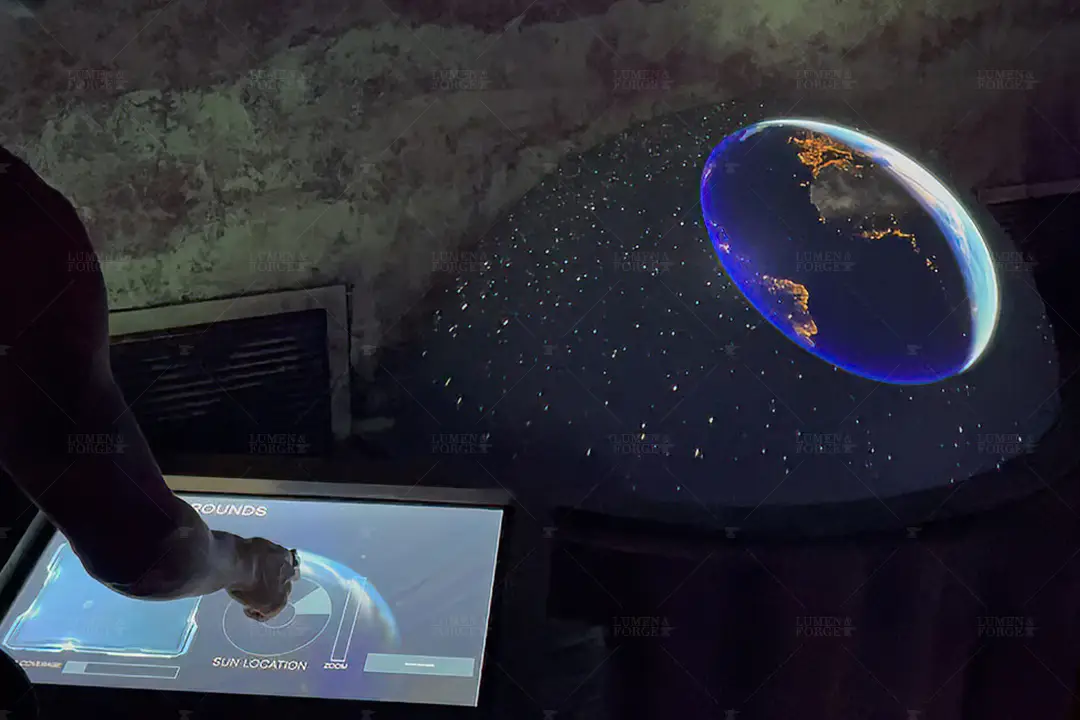
How a projection escape room reacts to the players
We blend projection mapping, interactive surfaces, sensors and real-time visuals so the story responds to the people in the room. Players can trigger animations, reveal hidden layers or change projected scenes as they work through the clues.
Behind the walls, every puzzle is a set of states. Deeper interactions can move a camera, drive an avatar with bone tracking or trigger scene states. Each input and state has to be designed and tested so the experience responds as intended.
What we build for a puzzle room
- The story comes first. We start with the story you want your audience to leave with, then work backwards to the technology that delivers it.
- Sensors that read the room. Skeletal tracking, depth cameras such as Azure Kinect, laser pucks and infrared can let players control projections with their bodies. We pick the tracking method based on the space and the story.
- Objects as keys. RFID pucks add physical-object interaction on a table surface, where placement and proximity drive behavior.
- Game logic. TouchDesigner and Notch help handle interactive logic and live visuals. They can read sensor data and pass parameters into Unreal. The logic is modular, so it can grow as the game takes shape.
- Progress between stations. NFC, RFID or QR codes can let each player carry a unique profile from one station to the next.
Puzzle styles that suit projection
Body puzzles turn movement into the answer. Guests can grow trees, trigger supernovas or paint walls just by moving.
Device puzzles bring phones into play. Augmented reality can let visitors solve digital puzzles on their own devices. A projection-mapped game can award points based on how players interact with it.
Replayable rooms keep returning teams guessing. Unlike a fixed video loop, interactive projection adapts to the audience, so no two visits are the same.
Story-led shows that guests simply walk through belong on our immersive theater page, and play floors for families on our interactive play page.
Interactive work we have delivered
We have not published an escape room project. Our closest published examples are interactive exhibits at the Toro Verde Interactive Museum in Puerto Rico, where Lumen and Forge serves as the park's technology partner.
- Retro Radiowaves: In a reimagined 1960s Arecibo Observatory control room, visitors find and decode radio signals by moving an antenna in six directions. The installation includes CRT monitors, oscilloscopes and analog controls.
- Portal Of Ages: Visitors open a door to reveal a generative AI landscape image, and a new landscape appears each time the door opens.
- Pressure Chamber: Visitors press buttons to select and crush different objects under simulated deep-sea pressure.
Questions about projection escape rooms
Yes. We build rapid proof-of-concept in-house so you can see the interaction working before we commit to a complete build, not after. It also helps align the creative direction and lock the technical approach early.
A raw sensor signal has to be interpreted and smoothed before it is mapped to a visual parameter. Integration then connects the sensors, logic and playback into one system.
Some. Interactive elements are tested on site with real visitors before launch, and sensors may need recalibration after heavy use. Conditions in the space, such as low light or reflective floors, can also affect tracking.
Didn’t find what you were looking for?
Our team is happy to walk you through your project and answer anything else
Plan your projection escape room
Tell us about the room, the story, how many players go in at once and how many puzzles you want. We will come back with how we would build the game, the sensors and the content. For the wider range of surfaces we map, see our projection mapping services, or contact our team to start.