


Halloween Projection Mapping for Haunted Facades and Scare Rooms
Halloween Projection Mapping for Haunted Facades and Scare Rooms
A good scare is about timing. A window that was empty a second ago now has a face in it. The corridor wall starts to breathe, and a sudden blast of air hits just as the lights drop. Projection and interactive effects let a haunt coordinate these moments without relying on an actor behind every door.
We design and build Halloween projection experiences for venues, attractions and brands, from the story and digital characters to the sensors that trigger them. If you are planning a haunt, tell us about the space and how scary you want it.
What Halloween projection mapping does for a haunt
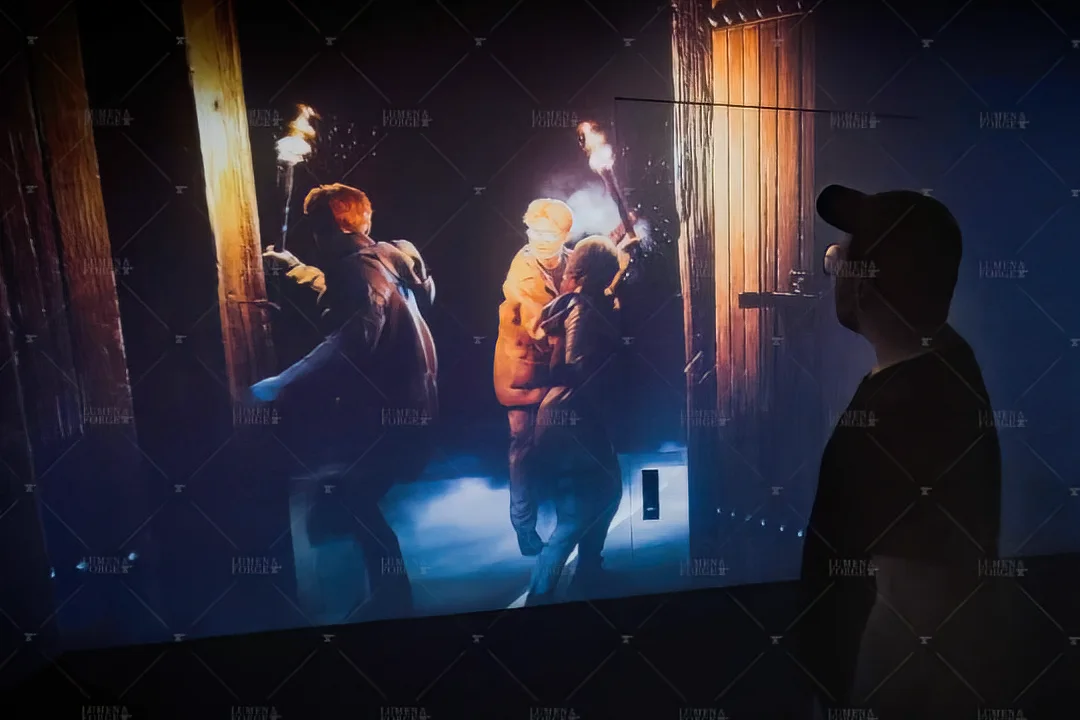
On a facade, content is mapped to align with architectural features like windows, columns and ledges. Ghosts can appear in the windows, while cracks and other effects can seem to spread across the stonework. Inside, projection mapping can turn plain maze walls into a rotting wood interior, a flooded crypt or a forest at night, with a different visual environment in each room.
What sets interactive Halloween experiences apart is the ability to react to guests. Motion technology like infrared sensors, cameras and LiDAR can detect audience movements. Stepping into a specific zone, for example, can trigger an environmental effect like wind or sound. Instead of playing the same sequence on a loop, the experience can respond to what guests do.
What we build for a Halloween attraction
- Creatures with real performances. Using our MOCAP studio, we capture live actor performances and turn them into digital narratives for immersive experiences.
- Apparitions in mid-air. Systems like Pepper's Ghost and advanced projection can simulate depth, making digital figures appear to float in the space.
- Triggered scares. Sensors and depth cameras can detect guest movement and trigger a scene, sound or environmental effect when someone enters a specific zone.
- Fog, wind and scent. We can add environmental effects such as wind, haze, rumble, scent and temperature changes to digital visuals. Scent diffusion systems can deliver specific smells at different points in an experience.
- Guests in the scene. Real-time camera ingest can composite guests into the visuals. Open a door, for example, and appear inside the haunted room on screen.
- Real-time content. Scenes can be built in Unreal Engine and rendered live. When combined with sensors and interactive logic, the experience can respond to guests rather than simply replay a fixed sequence.
Haunted facades, mazes and scare rooms
Haunted facades draw the queue. A short show on the front of the building, repeated through the night, tells passers-by what waits inside. Modern high-lumen projectors can cut through ambient city light, helping the facade remain visible in a busy outdoor setting.
Mazes and walk-throughs work room by room. Each zone can have its own look and interaction, so guests never know which wall or effect will respond next.
Scare rooms take the experience further. A small room can surround guests with projection and environmental effects, with the visuals, sound and physical sensations timed to the story.
Christmas shows have their own page. Puzzle-led rooms belong on our escape room page, and seated rides with motion seats on our 4D theater page.
Darker work we have delivered
We have not published a Halloween project. The closest published work is DreamBox360, where one of the experiences we built is a ghost ship.
- DreamBox360: We partnered with The LINQ Promenade to create DreamBox360, a 5D projection venue in Las Vegas that opened in 2024. Its experiences include "The Arctic Ghost Ship," featuring precision-mapped projections synchronized with environmental effects. The installation also uses custom-calibrated lasers and fog systems, with eight ceiling-mounted Optoma 4K projectors delivering 360-degree projections.
We used our MOCAP studio to transform live actor performances into digital narratives for the experiences. The Ghost Ship project was built in Unreal Engine and rendered in real time. The venue's 35-person capacity creates an intimate setting for each show.
Questions about Halloween projection
Sooner than you think. For seasonal holiday shows, our guidance is to book at least 8 to 12 weeks ahead, which allows 6 to 8 weeks for custom content creation.
Yes. Infrared sensors, cameras and LiDAR can detect movement, and interactive surfaces react to touch or motion captured by a depth camera, so each group gets the scare at its own moment.
Yes. Blasts of wind can be simulated with air jets, fans or compressed air systems, synchronized with what's on screen, alongside fog, haze and scent.
Didn’t find what you were looking for?
Our team is happy to walk you through your project and answer anything else
Plan your Halloween projection
Tell us about the building or route, the dates you open, how many guests go through each night and the story behind your haunt. We will come back with the scenes, the triggers and the effects we would build. For the wider range of surfaces we map, see our projection mapping services, or contact our team to start.