


An Immersive Theater Experience With the Audience Inside the Story
An Immersive Theater Experience With the Audience Inside the Story
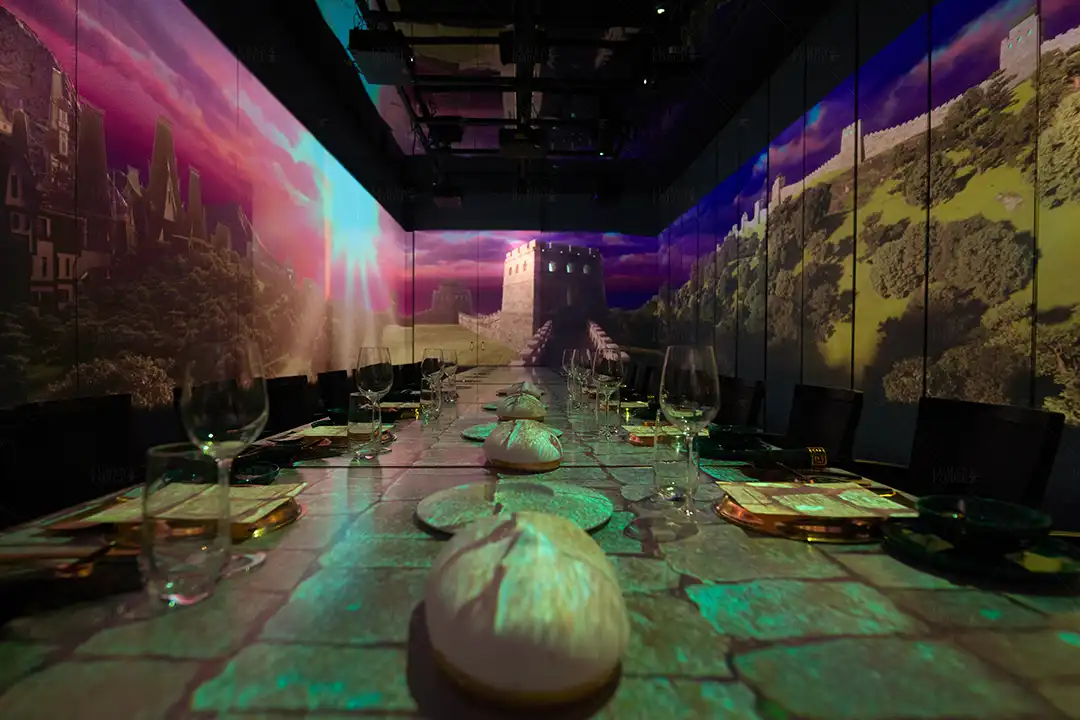
In a conventional theater, the story unfolds onstage while the audience watches from the dark. In an immersive theater experience, the walls become the set, the visuals surround the audience, and guests become part of the scene. Instead of watching the story from the outside, they step into a world that unfolds around them.
We build narrative experiences, from character-driven tales to ambient environments, for guests who belong inside the story rather than in front of it. If you have a story to tell, tell us about the story and the space.
What makes an immersive theater experience work
Immersive storytelling places your audience inside the narrative rather than presenting it on a screen in front of them. Guests may move through the space, touch interactive surfaces, trigger events, and influence what happens next.
The defining point is the story, not the hardware. We start with the story you want your audience to leave with, then work backwards to the technology that delivers it. From there, we blend projection mapping, interactive surfaces, sensors and real-time visuals so the story responds to the people in the room.
What we handle
- Storyboards for a room, not a frame. Immersive storyboarding maps a narrative to your space, so you plan what the audience sees in every direction, where each viewer stands and what pulls their attention.
- Interaction points, mapped out. Good immersive boards note what happens if a guest looks away, walks forward or triggers an event, along with timing, audio cues and lighting notes.
- Characters and worlds. We offer motion capture, photorealistic rendering, environment building, and stylized scenes and characters.
- Interactive content. We build with tools like Unreal Engine, Notch and TouchDesigner, so viewers can influence the storyline.
- Guests in the picture. With AR content, a guest steps onto a mark or through a door and is merged live into the scene, part of the picture rather than an observer of it.
- Pacing that holds. The goal is to make the experience readable and emotionally paced even when the audience has agency.
Story rooms, domes and branching shows
Story-driven rooms depend on structure. A coherent storyline provides structure instead of disorganized sensory input, and moments of wonder and contemplation can give way to rising action without bombarding the senses. The ending should leave time for reflection.
Domes wrap the story overhead. Surround video can play on screens or in immersive environments like projection domes, and our domes come in both geodesic and inflatable formats for events, exhibits and activations.
Branching shows split the room into players and watchers. In a two-screen story experience, one guest plays while a crowd watches the outcome above.
Physical effects can join the story too, from plants that respond when touched to rotating platforms or movable walls. They only work when they match the unfolding narrative, because poorly executed interactions feel gimmicky.
A show the audience watches from seats belongs on our theater and stage page, and motion seats, wind and scent on our 4D and 5D theaters page. Walk-through rooms, escape rooms and touring art shows each have their own pages too.
Narrative work we have delivered
These are our closest published projects, each built around a story the audience moves through.
- DREAMBOX360: For this venue on The LINQ Promenade, opened in 2024, we engineered the technical infrastructure and the creative content. Using our MOCAP studio, we turned live actor performances into digital narratives for experiences including "The Arctic Ghost Ship," "The Weekend Trip" and "Birthday Box," for groups of up to 35.
- The X Pot: In this dining room, 360° projections, synchronized light shows, spatial sound and responsive tech adapt to a 12-course meal, so each course becomes its own chapter of the story.
- Wild Child Lumens Gallery: We created five scenes of interactive content, including a terrarium where footsteps sprouted plants and an underwater realm with reactive jellyfish.
Questions about immersive theater
Yes, where the story is built for it. Interactive content lets viewers influence the storyline, and branching formats let one guest play while the crowd watches the outcome.
Yes. At DREAMBOX360, our scope included creating immersive 3D content using professional actors and motion capture technology.
By tying every effect to the story. Kinetic parts have to be built into the story, responding intelligently to match the unfolding narrative.
Didn’t find what you were looking for?
Our team is happy to walk you through your project and answer anything else
Plan your immersive theater experience
Tell us the story, the space, how many guests will be inside at once and how long the experience should run. We will come back with how we would board it, build it and pace it. For the wider range of surfaces we map, see our projection mapping services, or contact our team to start.