


Interactive Projection Play for Kids, Families and Play Spaces
Interactive Projection Play for Kids, Families and Play Spaces
Kids do not read the sign by the exhibit. They run at it, stomp on it and wave at it to see what happens. Projection built for play answers back. A footstep, a jump or a hand in the air changes what appears on the floor or wall, turning the room into something to explore rather than something to watch.
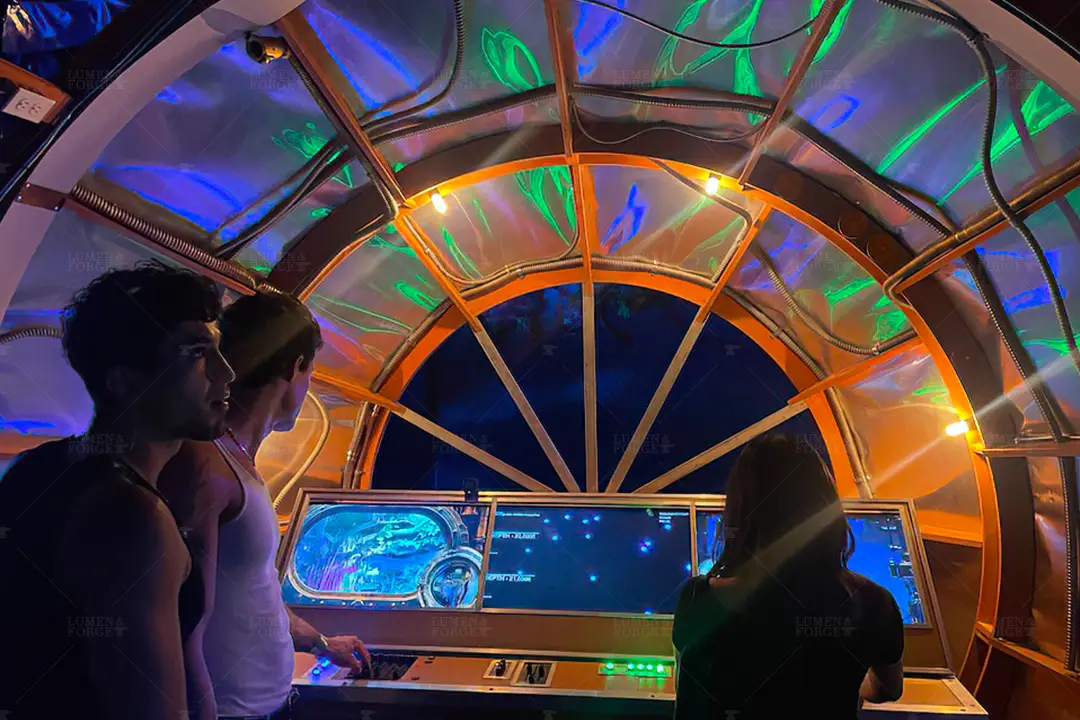
For Wild Child's Lumens Gallery in the Bay Area, California, we created a family-friendly immersive wonderland. If you are planning a play space, tell us about the room and who will be playing in it.
What interactive projection play looks like
Interactive projection mapping uses stimuli such as movement, touch or an object to manipulate projected digital content. Some of its most popular applications include games, museum exhibits and educational experiences.
A concrete floor can become a live game board, while a blank wall can become a highlight reel that responds to every step and cheer. A natural history exhibit, for example, can let a child "stir" a prehistoric sea with their hand and watch creatures react in real time.
Play is the hook. It lowers the barrier to engagement by giving people a reason to interact, encouraging curiosity and participation.
What we build for a play space
- Content made in-house. We build custom content, including 3D models, particle systems and interactive triggers designed to respond to sensors such as depth cameras, touch pads and motion detectors.
- Floors that feel the crowd. Infrared cameras and pressure-sensitive flooring can track movement and feed it into the interactive experience.
- Scenes that react to group size. For one activation, a network of cameras counted the people in a zone and adjusted animation density in real time. When the crowd reached a certain size, the floor filled with virtual confetti.
- Multiplayer games. We build four-screen Unreal Engine games networked with shared leaderboards for up to four players.
- Tuning with real visitors. Interactive elements are tested on-site with real visitors before launch. We adjust sensitivity, timing and content flow based on how people actually behave.
Floors, walls and domes for family play
Floors answer feet. At Wild Child, one scene was a magical terrarium where footsteps sprouted plants.
Walls answer hands. These surfaces react to human touch or motion captured by a depth camera.
Domes let a whole family share one picture. Family and friends can play together without the need for individual headsets.
Repeat visits are the goal for a play space. A projection that changes based on movement creates a loop of engagement that draws people back repeatedly.
General interactive installations for brands and events, interactive dance and lobby floors, walk-through rooms, escape rooms and photo-first selfie spaces each have their own pages.
Family and play projects we have delivered
We have not published a project page for a family entertainment center. These are our closest published projects.
- Wild Child Lumens Gallery: The interactive museum and play space featured games and activities complemented by motion-activated visuals and entrancing soundscapes. Scenes included a magical terrarium where footsteps sprouted plants, a geometric world of dynamic silhouettes, an underwater realm with reactive jellyfish and a playful carnival space with friendly blob creatures that followed visitors.
- Toro Verde Interactive Museum: As technology partner for Toro Verde Adventure Park in Puerto Rico, we built an interactive environmental museum. In Retro Radiowaves, visitors find and decode radio signals by moving an antenna in six directions. In Deep Sea Wonders, a kiosk area has buttons that trigger different coral reef light shows.
Questions about interactive play
For a large-scale fan-zone setup, we recommend a projection area at least 20 feet wide and a clear zone of about 15 feet in front of the surface for motion tracking.
At Wild Child, projection-mapped environments and touch-reactive elements invited kids and parents alike to engage with light and motion.
Depth cameras, touch pads, motion detectors or pressure-sensitive flooring tell the content where people are and what they are doing, and the visuals respond in real time.
Didn’t find what you were looking for?
Our team is happy to walk you through your project and answer anything else
Plan your interactive play space
Tell us about the room, the ages you expect, how many players at once and whether it is permanent or a pop-up. We will come back with the floors, walls and games we would build. For the wider range of surfaces we map, see our projection mapping services, or contact our team to start.