


Small Scale Projection Mapping for Products, Tables and Rooms
Small Scale Projection Mapping for Products, Tables and Rooms
Not every projection needs a skyline. Some of the best pieces fit on a counter, a plinth or the walls of a single room, where people can stand close enough to see the details. Working at a smaller scale changes the engineering: viewing distances are shorter, projector throws are tighter and every pixel is easier to spot.
We project customized content onto irregularly shaped objects, from consumer products to furniture and art installations, as well as the rooms around them. If you have a piece or a space in mind, tell us what you want to project onto.
What changes with small scale projection mapping
Viewing distance is one of the first things to consider. When people stand inches from a projected surface, you need higher pixel density and careful lens selection to keep the image crisp up close.
The arithmetic is simple. Pixel size equals image width divided by horizontal pixels. A 16-foot-wide image works out to 0.1 inch per pixel at HD and 0.05 inch per pixel at 4K UHD.
Brightness also works in your favor. Illuminance on a surface is proportional to lumens divided by area, so a smaller image concentrates the same light output over fewer square feet.
What we handle
- Measuring the piece. Photogrammetry can be used to create an accurate 3D rendering of the projection surface before content production begins.
- Content that follows the form. By mapping the surface geometry, we create pixel-perfect projections that follow every contour, so static objects appear to move, change color or display intricate patterns.
- Lenses for tight spaces. Short or ultra-short throw lenses keep beams above or below people and hide hardware near surfaces, and periscope UST lenses and mirror systems let a projector sit at floor level or tight to the ceiling.
- The resolution the piece needs. In small or medium-sized installations, such as 10-foot-wide surfaces or interactive booths, the visual difference between HD and WUXGA can be minimal to the average viewer.
- Quick content changes. A single projector and media server can switch from a holiday campaign to a new collection launch in minutes.
Products, single walls and whole rooms
Products and displays are the smallest canvas, and the closest look. Our object mapping page covers products and packaging in depth.
Storefronts and single walls often need just one unit. For a typical storefront window, a single high-lumen laser projector can cover a 10-by-15-foot area with crisp, bright imagery.
Whole rooms are a different job. Calibrated short-throw arrays can create a continuous floor-to-ceiling canvas in a compact footprint.
Small domes can be simpler than they look. For small domes, a single projector with a fisheye lens can cover the surface.
Tabletop dinner shows, cakes, sculptures and vehicles each have their own pages.
Small scale projects we have delivered
- Toro Verde Interactive Museum: Beneath & Beyond is a topographical 3D island map of Puerto Rico, where animated projection highlights different areas of the island as information appears on companion screens, looping automatically with no interaction.
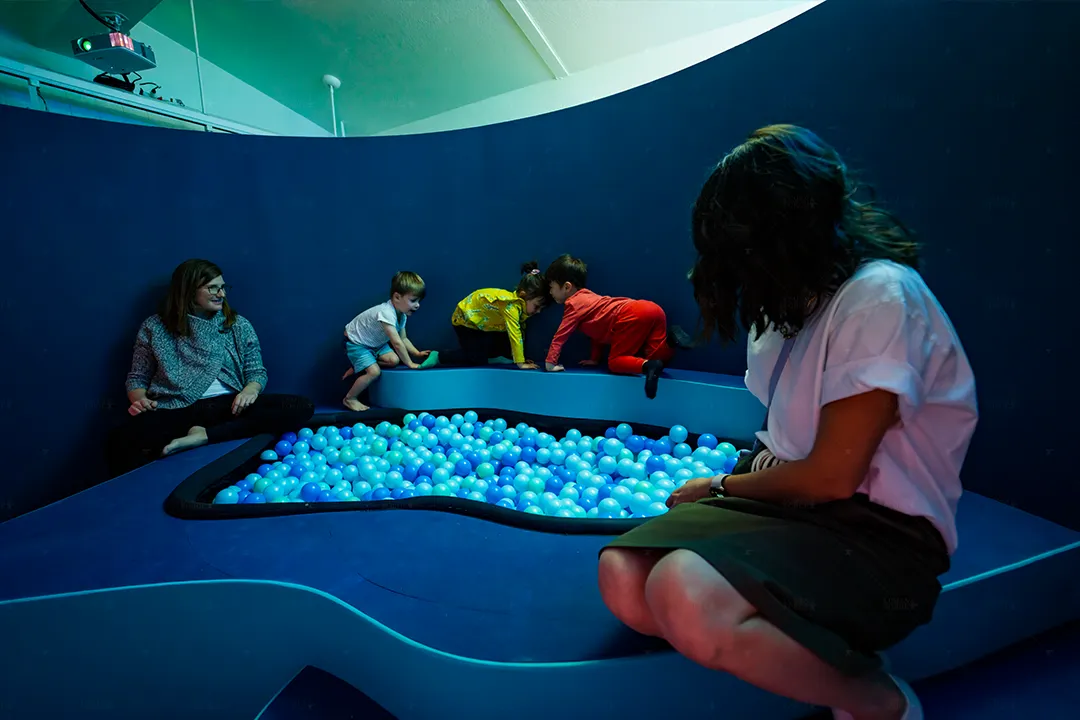
- Wild Child Lumens Gallery: In the Bay Area, four projectors and three motion-sensing cameras brought several projection mapped rooms to life, in a gallery that ran for four months in 2019.
- DREAMBOX360: On The LINQ Promenade, this venue opened in 2024 with a 35-person capacity, and eight ceiling-mounted Optoma 4K projectors create its canvas.
Questions about small scale projection
Usually. Small object mapping or single-storefront installations cost far less than large-scale building projections or multi-day event activations.
Less bright than outdoors. In dark, controlled rooms, many immersive walls look good in the 5,000 to 10,000 lumen range per projector, and indoor installations can use lower-lumen projectors without weather protection.
They can. If people stand close, they will be able to see the individual pixels, which is why viewing distance decides the resolution and the lens.
Didn’t find what you were looking for?
Our team is happy to walk you through your project and answer anything else
Plan your small scale projection
Tell us what you want to project onto, its rough size, how close people will stand and the light in the room. We will come back with how we would map it, which projector and lens we would use and what the content could do. For the wider range of surfaces we map, see our projection mapping services, or contact our team to start.