


Interactive Projection Mapping That Responds to Your Guests
Interactive Projection Mapping That Responds to Your Guests
Interactive projection turns a wall, an object or a whole room into something people can play with. A guest walks past, waves, taps a surface or presses a button, and the image answers them. We design, program and install these systems for brands, museums, venues and event producers who want an audience that takes part instead of standing back to watch.
Have a space in mind and an idea of what you want people to do? Tell us about your interactive installation and we will recommend the sensors, surfaces and content to bring it to life.
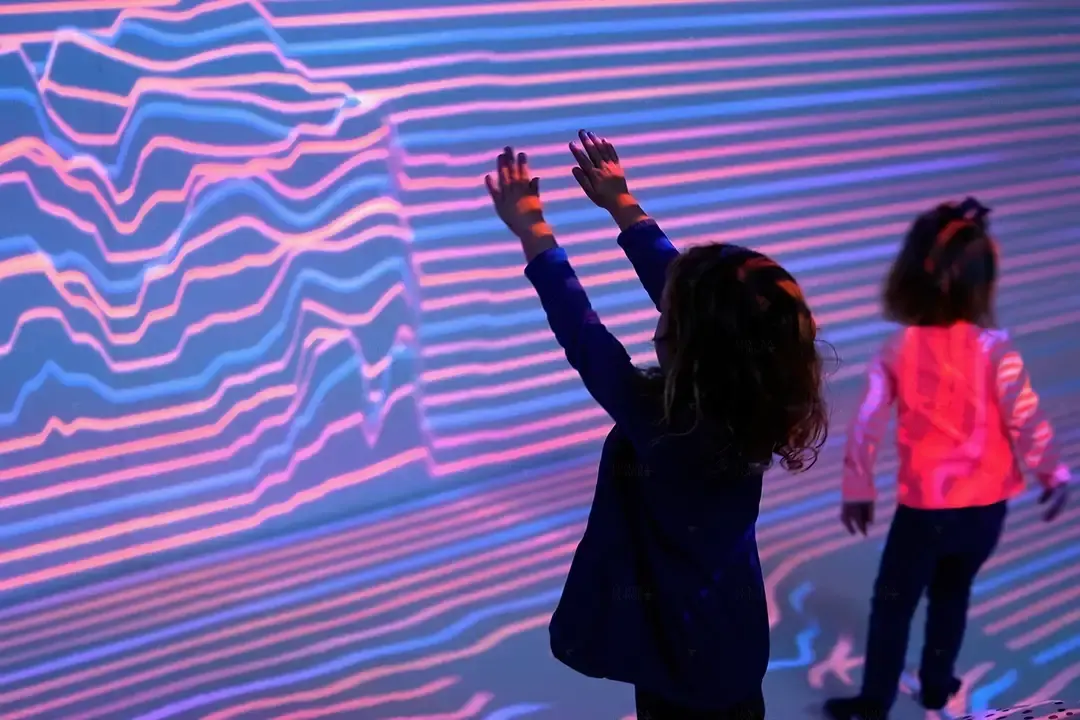
How interactive projection mapping works for your audience
Every interactive piece runs as a loop. On our builds, sensors pick up movement, touch or objects, and the projected visuals respond in real time to what people do. Software sits in the middle, deciding what each action should change before the projector redraws the scene.
The part that decides whether it works is legibility. A guest should see cause and effect almost the moment they act, or they assume the wall is just playing a video and move on. We tune the response so the link between input and outcome is obvious, and so the payoff rewards anyone who joins in.
What we build and run for you
- Sensing and tracking. Azure Kinect, skeletal tracking, laser pucks and infrared let guests steer projections with their bodies, and we choose the tracking method to suit the space and the story.
- Touch on almost any surface. Laser pucks turn a projected wall or table into a touch surface, while RFID pucks let objects placed on a table change what it shows.
- Content that reacts. Our team builds scenes in Unreal Engine, TouchDesigner and Notch that are triggered by sensors, closer to a small video game than a looping film.
- A working prototype first. We prove the interaction in our own shop, so you see it working before we commit to a full build.
- Fabrication, software and show control. Enclosures, content, programming and show control come from one team under one roof, so the pieces fit when they meet on site.
- Install and support. We deploy on-site or support the system remotely, ship machines pre-configured and stay on call for the whole run.
Walls, objects, exhibits and facades
The surface changes what kind of interaction makes sense, and so does how long each guest will stay.
Walls suit motion. People react to a wall that answers as they pass, so it works in lobbies, booths and corridors where traffic keeps moving and nobody needs instructions.
Objects suit curiosity. With interactive 3D projection mapping, a guest taps a touchscreen and the mapped object in front of them opens up, showing wireframes, moving systems and cutaways. We can ship the whole piece in a rolling enclosure that opens for the show and closes for the truck.
Exhibits and rooms suit learning. Buttons, touch displays and motion sensing let visitors trigger a scene, explore it at their own pace and see the result of each choice, which is why museums and education spaces use this format so often.
Facades suit crowds. A building can carry a game that many people watch while a few play, as long as the content is built for the architecture.
Interactive projects we have delivered
- Wild Child Lumens Gallery: For this Bay Area pop-up children's museum, which ran for four months in 2019, we created five scenes of interactive content using four projectors and three motion-sensing cameras. Footsteps sprouted plants in a magical terrarium, and jellyfish reacted to visitors in an underwater room, all adjustable from a tablet.
- Toro Verde Interactive Museum: At this museum in Puerto Rico, touch-activated displays and projection mapping turn natural science into hands-on exhibits. In Deep Sea Wonders, kiosk buttons trigger different light shows across a sculpted coral bed.
- BITMAIN at WDMS 2024: At the Fontainebleau Las Vegas, our dual Barco projector setup running Notch created a wall that responded to visitors' movements with real-time effects.
- Tropicana world record: In 2022 we built the world's largest video game screen at The Tropicana, recorded at 47,397 square feet, where athletes and celebrities on hand played a multiplayer game in real time.
Questions buyers ask before booking
It depends on the room and on what you want guests to do. Depth cameras and skeletal tracking suit full-body play, laser pucks suit touch on a wall or table, and buttons or RFID suit exhibits where people handle objects. We recommend one once we understand the space and the story.
For a turnkey trade-show interactive, our typical schedule runs from the brief in week 1 to a full tech pass in week 8. Licensed solutions can be compressed to as little as 4 weeks.
Yes. We design capture into the experience rather than bolting a form on afterwards. A universal QR code and a randomly generated ID let each guest pull up their own score, configuration or image.
We do, either on-site or remotely, and we stay on call for the whole run. Shared technical topics such as ambient light and projector placement are covered on our projection mapping services page.
Didn’t find what you were looking for?
Our team is happy to walk you through your project and answer anything else
Start your interactive project
Send us the venue or room, your dates, who the audience is and the one thing you want guests to do. We will suggest the sensors, surfaces and content that make that action feel natural. You can browse every platform we build on our programming and interactivity page, see the wider range of mapping work under projection mapping services, or contact our team to get started.