


Event Projection Mapping for One-Night and Short-Run Shows
Event Projection Mapping for One-Night and Short-Run Shows
Some shows last only one night. The venue opens in the afternoon, the crew has a few hours to build, the audience arrives, and by morning, the room has to look as if nothing happened. On a job like this, the planning can make or break the show.
We scope, design, engineer and operate temporary projection for brands, agencies and event producers. If you have a date and a venue, tell us about the event and how long it runs.
Why event projection mapping suits short runs
Projection systems are the ideal solution for temporary events of any scale because they're easy to transport and much more convenient when you need to display large-scale visuals. Our own comparison puts it plainly: LED is best for long-term use in a permanent location, whereas projection is best used for temporary activations.
For short-run events, the biggest challenge is often the time available on site. Accurate plans, drawings and test content help the crew resolve issues before load-in, rather than losing valuable hours to troubleshooting at the venue.
What we handle for a temporary show
- Previsualization. Our previz catches scale issues, timing problems and technical conflicts before load-in, when design changes still happen in planning instead of costing labor hours and rental days.
- Site details up front. Discovery covers venue measurements, ceiling height, rigging points, power and ingress.
- Testing before travel. We stage the entire system, document golden images and lock firmware versions before travel, and run full signal chain tests before load-in.
- A load-in and load-out plan. You get a load-in/load-out plan that keeps the build efficient, safe and predictable, and we coordinate with your load-in schedule to minimize disruption.
- Spares on hand. Backups mean spare gear and a rollback plan.
- Strike. Teardown is planned like the build, around venue access and crew size.
One night, a few nights or a weekend
A single night is mostly about the clock. A single-room club setup typically installs in 4 to 8 hours, including rigging projectors, calibrating alignment and testing content, and strike and teardown usually take 2 to 4 hours, depending on venue access and crew size.
Multi-night runs can loop or trigger the same show each night once the content and setup are finalized. For longer runs, we can schedule minor content variations, such as different color palettes or logo animations, to keep the experience fresh.
Larger builds need more room in the schedule. A standard installation takes one to three days for setup and calibration, plus additional time for content creation.
Outdoor nights add weather to the plan. Outdoor installations require weatherproof gear and more powerful projectors to combat sunlight.
A system that stays in place for months or years is a different build, covered on our permanent installations page. Pop-ups, grand openings and touring shows also have their own pages.
Short-run events we have delivered
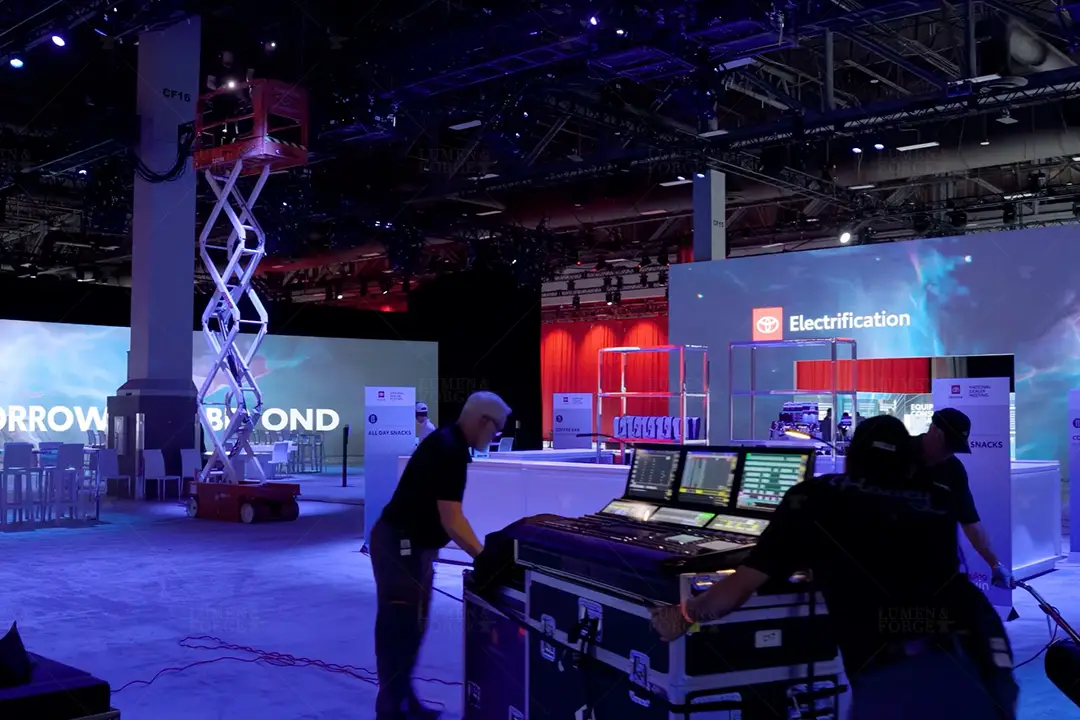
- Toyota National Dealer Meeting: At Mandalay Bay, six Panasonic PT-RQ22KU 4K projectors lit the curved front wall while twelve Barco UDX-4K32 projectors covered the surrounding walls, with edge-blending and color calibration across every surface.
- Tropicana world record: In 2022 we set the record for the world's largest video game screen, at 47,397 square feet, live-streamed to tens of thousands of viewers. The build used thirty-eight Barco projectors plus a few spares, fifty units in total.
- Don Julio at the Stratosphere: The show ran for 4 nights, from 7 pm to 2 am each night, from two scaffolding rigs with custom weatherproof enclosures for the projectors.
Questions about temporary projection
It depends on the scale. For a standard single-room club setup, we recommend starting the conversation at least four weeks out, which gives room for a site survey, custom content development and testing. Larger shows need longer.
It depends on how often you run. If you only light a few days per quarter, the rental market gives you fresh inventory when you need it, and if every venue is different, renting lets you swap lens types and output levels without owning every configuration. Choosing and supplying the gear itself is covered on our equipment rental page.
Spares and a rollback plan are part of the build. Renting can also shift a meaningful chunk of that risk to the vendor, especially when the package includes rapid-swap programs and guaranteed replacement timelines.
Didn’t find what you were looking for?
Our team is happy to walk you through your project and answer anything else
Plan your event projection
Tell us the venue, the date, how many nights it runs and how long you have for load-in and strike. We will come back with how we would build it, test it and take it down. For the wider range of surfaces we map, see our projection mapping services, or contact our team to start.