

Light Festival Projection Mapping for Cities and Light Trails
Light Festival Projection Mapping for Cities and Light Trails
A light festival is not one show. It is the same piece of work playing to a new crowd every night for weeks, in rain, cold and wind, to families who walk past it on their way to the next stop. The projection that wins a festival is the one still holding its colors on the last night, with people stopping to watch it a second time.
We create projection pieces for festival organizers, cities, downtown districts and sponsors, from a single landmark facade to a string of stations along a light trail. If you are planning a festival or adding projection to an existing one, tell us about your festival.
What light festival projection mapping has to do
Light festival projection mapping is built for a run, not a night. A one-night activation at a venue like the Charleston Music Hall carries a different scope than a multi-week installation tied to Spoleto Festival USA or the Holiday Festival of Lights. That difference shapes everything from the rig to the content.
The point that defines festival work is the moving audience. Along a festival route, people arrive in groups, on foot, and in motion. What holds a crowd is narrative and participation: content that reveals something over time, responds to movement, or gives people a reason to stay for the second and third beat. A loop has to reward someone who arrives halfway through it, then make them wait for the next one.
What we deliver for a festival run
- Pieces made for the site. Every piece is designed around the surface, the route and the crowd it has to hold, not adapted from a stock loop.
- Interactive stations. A static holiday show might be a one-time draw, but an interactive one evolves with each visitor's actions, which gives repeat visitors something new. Sound-based interaction works best for large crowds, while motion-based interaction is better for smaller, intimate spaces.
- Rigs that survive the season. We use high-lumen projectors and specialized enclosures for rain or cold, and design content with higher contrast to remain vivid under streetlights or moonlight.
- Image that holds for weeks. For long-term installations, we employ camera-based auto-alignment that continuously adjusts brightness and color so the system stays locked in.
- No dark nights. For live events, we run two media servers in parallel, with automatic failover, and we keep spare projectors on site.
- Crew for the run. We bring our own media servers and often provide on-site technicians for the duration of the show.
For gardens and parkland, see tree projection mapping. For shows locked to a soundtrack, see music synced projection mapping, and for year-round night tourism, see tourism projection mapping.
Landmark headliners, trail stations and festival sponsors
Landmark headliners turn one building into the image the festival is remembered by. For a building facade, the audience needs a clear, unobstructed zone at least 50 to 100 feet away, so the viewing area is planned with the route, not after it.
Trail stations spread the work along a walking path. Each stop needs its own reason to pause, its own power and a rig that sits outside the flow of people moving to the next one.
Sponsor pieces give a brand a place on the festival map. The content carries the sponsor's story inside the festival's theme rather than as an ad dropped onto it.
Seasonal festivals already fill city calendars. The Milwaukee Holiday Lights Festival runs from mid-November through January 1 across the downtown parks and Wisconsin Avenue, the Magnificent Mile Lights Festival kicks off the holiday season in Chicago in November, and the Portland Winter Light Festival takes over February.
Seasonal night shows we have delivered
- The Venetian holiday show: With BESTAgency, we mapped the St. Marks Clock Tower inside The Venetian with holiday projection timed to live music. The content was processed in advance, so the 17-minute show ran at the press of a button from a single 32k lumen 4K Christie Boxer projector.
- Chabad of Summerlin Chanukah: For an outdoor Chanukah celebration, we mapped the synagogue with two 4K projectors set at opposite sides of the building and edge-blended into one image.
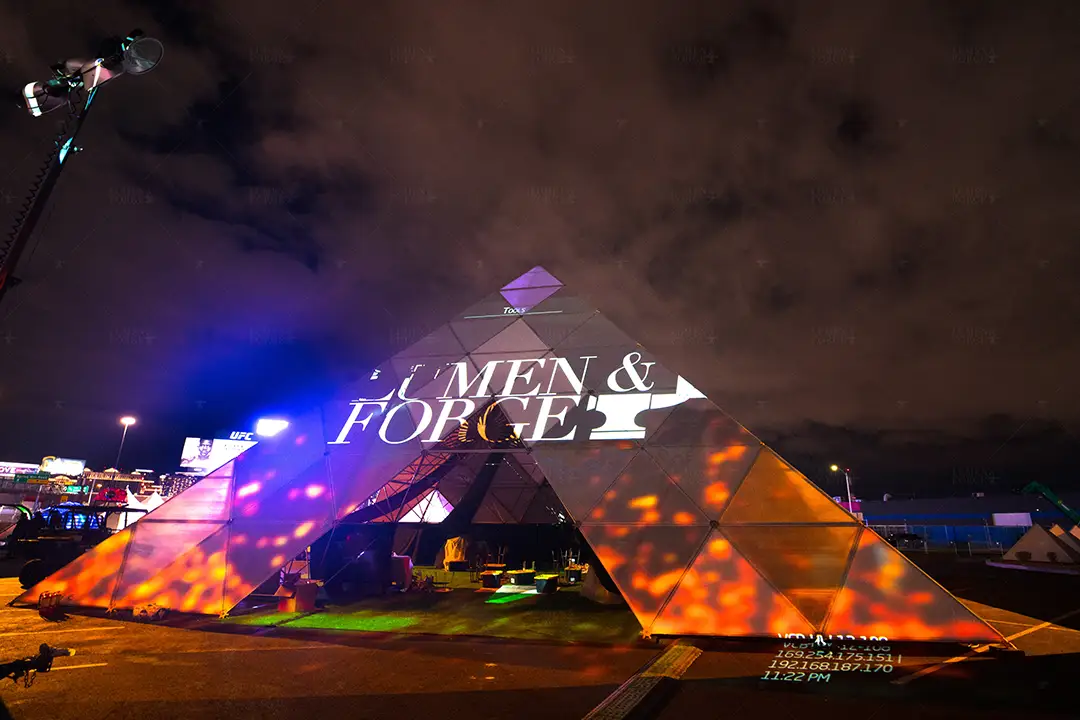
- Playa Playground NYE at Area15: For a New Year's Eve fundraiser, we built a 50-foot pyramid as the event's centerpiece and mapped it with four Barco UDX W32 projectors, each delivering 32K lumens.
Questions festival organizers ask
For holiday shows, start planning by late summer. We recommend booking at least 3 to 6 months ahead, as venue availability and production slots fill quickly during peak season, and a custom project typically requires 8 to 12 weeks from initial concept to final content.
Rain or snow can reduce brightness slightly, but our systems are designed to handle cold and damp conditions, and we adjust content contrast to remain vivid in ambient city lights.
We recommend a site visit at least six weeks before the event to confirm measurements and test projection angles.
A single-building facade projection for one night might start in the mid-five figures. A multi-week run, several stations or interactive pieces are quoted once we know the route and the dates.
Didn’t find what you were looking for?
Our team is happy to walk you through your project and answer anything else
Plan your festival with us
Send us the festival dates, the route or site map, the surfaces you have in mind and the crowd you expect each night. We will come back with which pieces would anchor the route, how they hold up across the run and a timeline to opening night. Browse our projection mapping services, or contact our team to start planning.