


Tree Projection Mapping for Gardens, Parks and Landscapes
Tree Projection Mapping for Gardens, Parks and Landscapes
After dark, a garden stops being scenery and becomes a stage. Light ripples through a canopy, color climbs a trunk, and a path between hedges turns into a walk through moving art. There’s no screen to build. The trees are the canvas.
We bring projection to the living parts of a site: the trees around a home, the gardens and planting of an outdoor event, the grounds of a private estate. If you have grounds you’d like to light up, tell us about the space and the night.
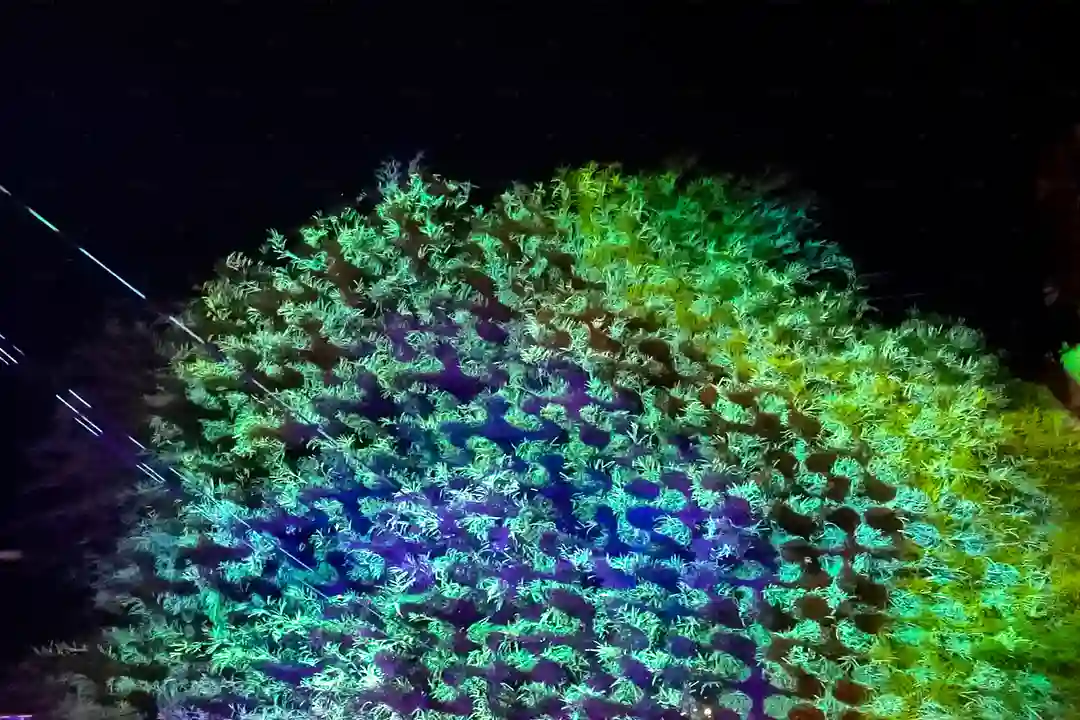
How tree projection mapping works on living surfaces
Tree projection mapping treats foliage, trunks and planting as the projection surface, with content built for their shape rather than for a flat screen. That shape is the challenge. Even the most ordinary plants and trees do not grow into large, flat canvases; they have intricate surface textures and fine details, and constant growth and organic change affect the surface too.
The one point that defines the work is the viewer's position. On a canopy, the image looks best when the viewer watches from the same perspective as the projector. Step to one side and the image will warp and scatter in the tangle of uneven branches. So we plan where guests will stand before we plan where the projectors go.
What we take on for a garden or park show
- A viewing plan first. We place projectors to share the guests' line of sight, and we keep key visuals out from behind pillars, trees or street furniture that would block them.
- Distance on our side. A larger projection distance helps reduce distortion on an uneven surface, so we look for positions that give the beam room.
- Scans timed for still air. Trees change between scan passes, so we capture quickly and schedule scans when movement is minimal.
- Content that suits foliage. Darker colors disappear on a dark surface because it does not reflect light, so we design with lighter colors and strong contrast.
- Kit for the outdoors. Outdoor work needs weather-proofing and high-lumen projectors to cut through the glow around a site.
- Lighting alongside projection. On grounds where projection carries the trees, RGB lighting can carry the gardens around them.
Single trees, gardens and open landscapes
A single tree or a tree line. A specimen tree or a row along a drive makes a strong focal point. Because the image holds best from one viewpoint, these suit an arrival moment or a spot where guests gather.
Gardens and courtyards. Here projection often shares the space with walls and built features, so the content can move from a wall into the planting and back. Each type of plant takes light differently. When Klip Collective mapped Longwood Gardens for Nightscape, content that worked on some plants did not work on others, so testing on the real planting matters.
Parks and open landscapes. Larger grounds call for several projector positions working together, as at Picnic in the Alley below.
Brightness and weather for open-air sites are covered on outdoor projection mapping, and rock faces have their own page on mountain projection mapping. Shows on the house itself are on house projection mapping. For images that seem to float in the air over a lake or lawn, see water screen projection and fog screen projection. City trails are on light festival projection mapping, and holiday shows on Christmas projection mapping.
Gardens and grounds we have lit
- Picnic in the Alley, Las Vegas. For the Dress for Success fundraiser, we installed 13 projectors powered by four media servers to cover thousands of square feet of walls and foliage.
- US Marines Annual Birthday Ball. For the past 4 years we have mapped the home that hosts the ball. Two projectors face the house while a third augments the surrounding trees with undulating visuals, and the team added extensive RGB lighting in the trees and gardens.
- Big Sur private party, California. Alongside the dome venue, the event featured projection mapped features around the rest of the property.
Questions about projecting onto trees
Not clearly. With such a fragmented surface, the projection is only clearly visible at night, when the dark sky helps create more contrast between the image and the foliage.
Foliage is never perfectly still, so movement is part of the plan from the first scan, which we time for the calmest conditions we can get.
Yes. With skeletal tracking, depth cameras like Azure Kinect, laser pucks and infrared, guests can control projections with their bodies. Our programming and interactivity team builds those systems.
Didn’t find what you were looking for?
Our team is happy to walk you through your project and answer anything else
Plan your garden or landscape show
Send us photos of the trees and grounds, your event date, and where guests will walk and stand. We will come back with where the projectors can go and what the planting can carry. You can browse every surface we map on our projection mapping services page, or contact our team to begin.