
Projection Mapping Content Creation, Built for Your Surface
Projection Mapping Content Creation, Built for Your Surface
A normal video is made for a rectangle. Projection content is made for one particular building, dome, car or stage, and it only looks right on that shape. Get the content wrong and the best projectors in the world will still show a picture that slides off the edges.
We write, design and animate the content for our projection shows in-house, from the first storyboard to the final render. If you have a surface and a story to tell on it, send us the brief.
What projection mapping content creation involves
Projection mapping content creation means producing animation for one specific surface rather than for a screen. Content has to be custom made for the object in mind, and photogrammetry can give us an accurate 3D rendering of the surface before production starts.
The defining technical step is animating on that model. The scan becomes a mesh with UVs, so our artists can paint content straight onto the geometry and build every animation on the same mesh. That way the frames we render already match the real building, product or set when they reach the projectors.
What our content team delivers
- Storyboards and moodboards. Every project starts by setting the visual style, tone and format. For immersive spaces we plan the story in every direction, including where the viewer stands and how their attention moves.
- 3D modeling and environments. Our full-service 3D animation studio covers environment building, photorealistic rendering, and stylized scenes and characters.
- Motion capture. When a show needs real performance, our MOCAP studio turns live actors into digital characters.
- Content sized for the projectors. We design around blend zones, aspect ratios and resolution scaling, so nothing important falls into a seam. More projectors mean more pixels, so render times and playback are planned from the start.
- Previsualization. Before anything goes on-site, previz lets us test sightlines, scale the content to the real venue and rehearse cue timing.
- Interactive and live-ready files. We build in Unreal Engine, Notch and TouchDesigner when content needs to react, and we can bring in assets your own creative team or resident VJ already makes.
For the wider studio, including VR, character animation and game visuals, see animation and visual storytelling.
Facades, domes and objects each need their own pipeline
Each type of projection mapping needs a different content pipeline, projector spec and calibration, so we plan the workflow around the surface first.
Facades and buildings. Content follows windows, ledges and the building's own perspective. Depth illusions that make a wall open or crumble are covered on 3D projection mapping.
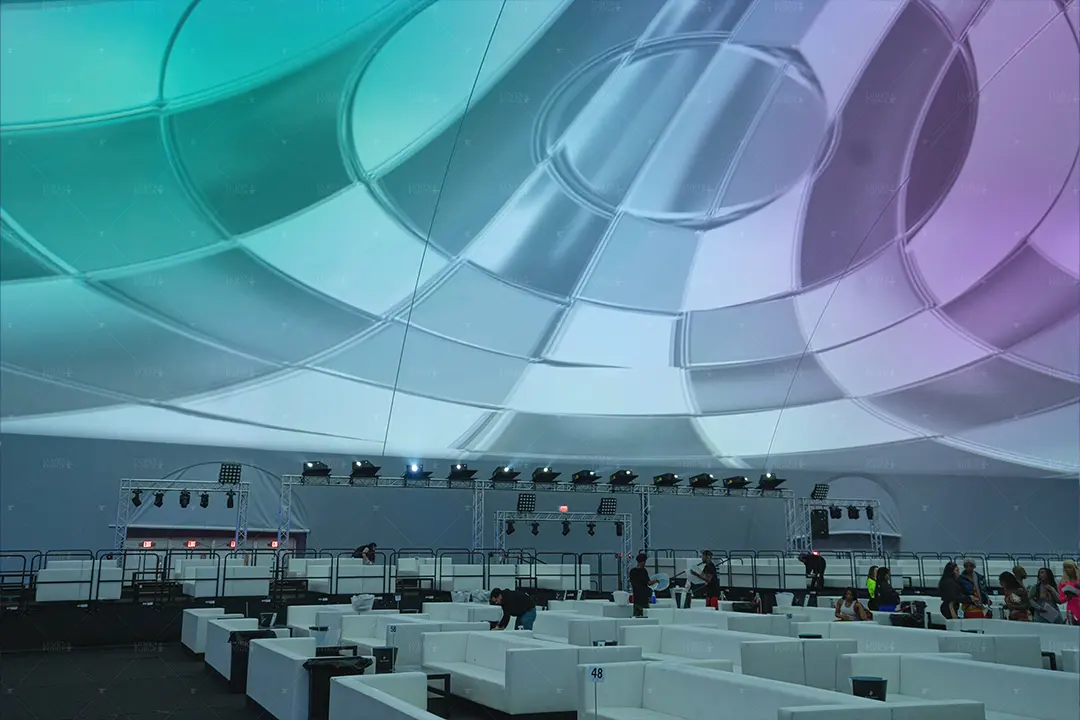
Domes. A dome needs content rendered at ultra-high 360-degree resolution, which we can produce as animation, 3D work or captured live action.
Objects and sets. Products, sculptures and set pieces often sit close to the audience, and when people stand near a surface the image needs higher pixel density to stay crisp.
Content generated live from cameras or data feeds is covered on real-time projection mapping, and shows cut to a soundtrack on music synced projection mapping.
Content we have produced
- Dreambox360, Las Vegas. We created immersive 3D content using professional actors and motion capture, and our in-house animation team built experiences including "The Arctic Ghost Ship," "The Weekend Trip" and "Birthday Box."
- The Dome in Miami. The 225 x 175 foot dome was pill shaped, so our content had to be custom rendered to stretch across the liner. Our creative team produced over an hour of custom 4K Domemaster content.
- Tropicana world record, Las Vegas. Our in-house creative designers built the gaming imagery and live-fed it so the game could be played in real time, while our FORGE ANVIL server adapted the feed to the building's forced perspective.
- The Venetian Holiday Spectacular, Las Vegas. Our creative team designed festive characters, animations and patterns, including the 12 Days of Christmas, for the St. Marks Clock Tower.
Content questions clients ask
For a concert, a typical production needs 4 to 6 weeks of content creation, depending on how complex the visuals are and how many songs the show covers. Other shows are scoped on the brief.
Yes. We can integrate assets your own creative team or resident VJ already produces, and build the mapped content around them.
Yes. Once a surface is captured, the model becomes a reusable asset for seasonal shows or touring versions, so a new show can start from the same mesh.
Didn’t find what you were looking for?
Our team is happy to walk you through your project and answer anything else
Start your content brief
Send us the surface, the date, the story you want to tell and any brand assets you have. We will come back with a storyboard approach and a production plan. See every surface we map on our projection mapping services page, or contact our team to begin.