


Real-Time Projection Mapping for Live Feeds and Generative Visuals
Real-Time Projection Mapping for Live Feeds and Generative Visuals
A rendered show plays the same way every night. A live one never does. When the picture is built in the moment, it can carry a camera feed, a score, a game or the crowd itself, and nobody in the room has seen it before.
We build live-driven projection for brands, venues, tours and events, from building facades to domes and brand activations. If your show needs to change with the night, tell us what should drive it.
What real-time projection mapping does differently
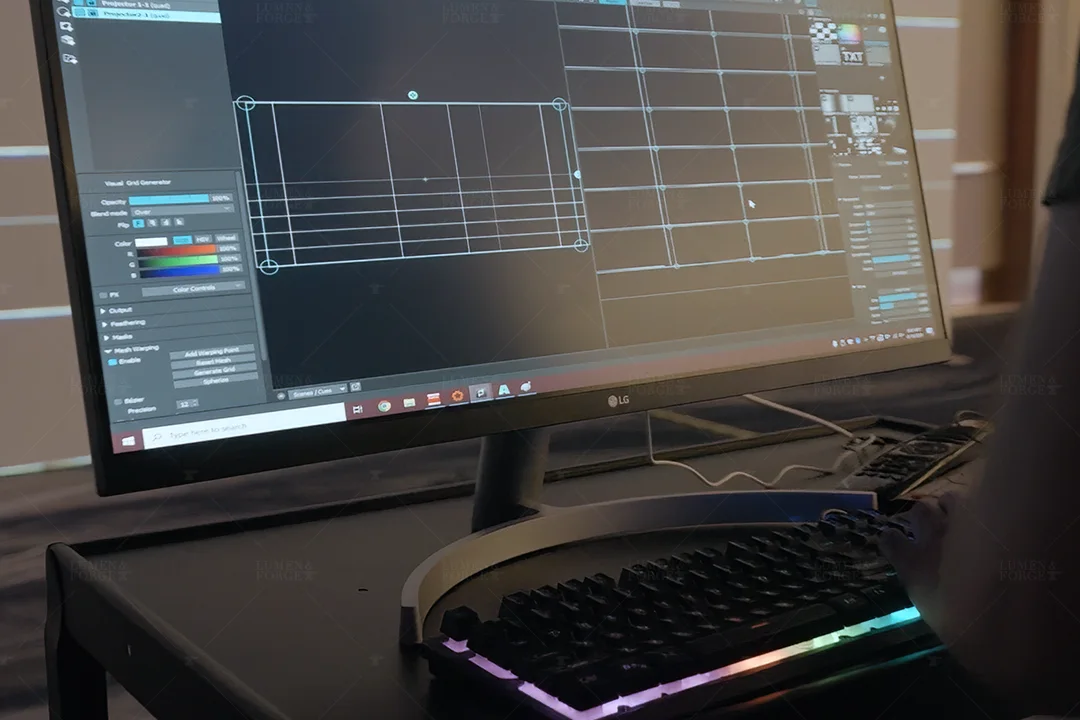
Real-time projection mapping generates or drives the image live, so visuals react to performers, live data, cameras or sensors instead of running from a pre-rendered file. That makes it a fit for live shows, retail activations and sports environments, where timing and audience energy change from minute to minute.
The defining challenge is keeping the illusion intact. A mapped image only works if it stays locked to the surface, and live content gives the system no rehearsed frame to fall back on. We build systems that keep alignment while content is generated or driven live, so the picture holds under pressure. Working live also means the look can be tuned on site: brightness and contrast for the ambient light, and pacing for the room.
Live inputs we work with
- Live camera feeds. Real-time camera ingest merged with generated visuals turns the audience into the content, and the content is always new. On a dome, live camera feeds or VJ content can be mapped onto the surface.
- Camera portals and composites. In our installations, that often takes the form of camera portals and composite setups, where a guest steps onto a mark or through a door and is merged live into the scene.
- Generative and game-engine content. Our team builds with Unreal Engine, Notch, TouchDesigner and more, and stays platform-agnostic so we can reach for whatever delivers the best guest experience.
- Motion capture. Motion capture records real human movement and maps it onto digital characters or visuals in real time.
- Live data and configurators. Real-time interfaces can hold millions of combinations, so a product configurator can redraw a car, a livery or an outfit the moment a guest changes it.
- Live VJ mixing. A VJ can cut and layer clips to the room as it happens, which is how we ran the League of Legends afterparty below.
Sensors and gesture control are covered in full on interactive projection mapping, and audio-reactive shows on music synced projection mapping.
What keeps a live show running
Latency. Visuals have to answer their input fast enough to feel connected. Our systems often process input in real time with less than 50 milliseconds of latency.
Redundancy. Live events cannot pause for a crash. Our media server setups play content in sync with redundant systems to handle any failures during live events.
Calibration that holds. Alignment has to survive a long night as well as a live feed. Drift fixes and service plans have their own page on auto-calibration and maintenance.
Content behind the feed. Generated visuals still need designed assets, styles and rules. Our projection content creation team builds them, and the systems side sits with programming and interactivity.
Live projects we have delivered
- Tropicana world record, Las Vegas. Our in-house designers built the gaming imagery and live-fed the content so the game could be played in real time on the facade. With our custom FORGE ANVIL server, we manipulated the content feed to adapt to the forced perspective of the building. The display was recorded as 47,397 square feet and live-streamed to tens of thousands of viewers around the globe.
- League of Legends All Stars afterparty, Las Vegas. We edited the videos into VJ-friendly clips that fit the 360 space, and our VJs live-mixed the content to accompany the music and activities of the night.
- BITMAIN at WDMS. Our dual Barco projector installation, powered by Notch software, created a wall that responded to visitors' movements with real-time visual effects.
For stadium and esports formats, see stadium and arena projection and esports and game launches. Phone-based layers are covered by augmented reality projection mapping.
Real-time projection FAQ
Not always. Pre-rendered content suits a fixed show that runs the same way each time. Real-time earns its place when the show has to react to a feed, a performer, a game or the audience.
Usually, yes. Tell us what the feed is and how it arrives, and we will plan how it is ingested, styled and mapped to the surface.
That is what redundancy is for. Our media server setups include redundant systems for live events, and a live show can be designed to fall back to prepared content.
Didn’t find what you were looking for?
Our team is happy to walk you through your project and answer anything else
Plan a live show
Tell us what should drive the visuals, the surface or space, the audience and your dates. We will come back with an input plan, the tools to build it in and a system design. To see everything we do, visit our projection mapping services page, or talk to our team.