

360° Dome Projection for Retail & Storefront Displays
{{actual_date_posted}}
How 360° Dome Projection Transforms Retail & Storefront Displays
In the crowded retail landscape of Las Vegas, grabbing a passerby's attention is only half the battle. The real challenge is keeping them there long enough to turn a glance into a sale. Traditional storefronts—static signage, flat video walls—blend into the Strip's visual noise. A 360° dome projection, however, creates an entire environment that stops traffic, extends dwell time, and makes your brand the destination, not just a stop.
Why 360° Dome Projection Works for Retail & Storefront Displays
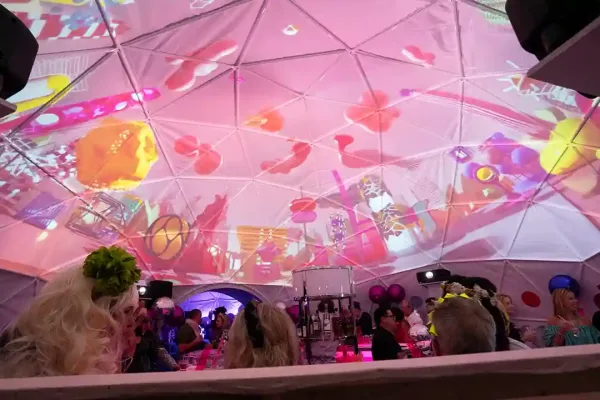
Retail success depends on foot traffic and conversion. A 360° dome projection does both by leveraging the psychology of immersion. When shoppers step inside a dome, their peripheral vision fills with dynamic, branded content—no edges, no distractions. This full-field experience triggers a stronger emotional response than a flat screen, making the brand narrative feel personal and immediate. For a shoe launch, you aren't just showing sneakers; you're placing the customer inside a windstorm or a stadium crowd. That sensory memory directly correlates with purchase intent.
Domes also solve a practical problem: they create a controlled viewing space within an open storefront. In a mall or on the Strip, competing lights and sounds dilute your message. A dome's interior is a dark, quiet canvas where your content owns 100% of the viewer's attention. This is why we built the "Beneath the Blue" 360° dome for National Geographic—the enclosed format made the ocean feel real, not like a video. For retail, that same principle turns a product demo into an event. And because the dome itself is a striking architectural object, it acts as a beacon even when empty, drawing curiosity from across the concourse.
What a Lumen & Forge Dome Production Involves
Executing a retail dome installation is a blend of creative storytelling and precise engineering. Here is what a real project from Lumen and Forge entails, from concept to opening day.
Custom Content Creation. We begin with your campaign goals. For a storefront display, the content must loop seamlessly, with a clear call to action at the end of each cycle. Our team designs 360° video or real-time graphics that wrap around the viewer. We avoid generic stock footage—every asset is tailored to your brand's color palette, logo, and product. For example, when we projected the world's-largest video game screen on the Tropicana facade, the content was built specifically for that surface's geometry and the pedestrian sightlines. A dome is no different: the visuals are warped in post-production to map perfectly onto the curved surface, so nothing looks distorted.
Projector and Media Setup. A typical retail dome uses 4 to 6 ultra-short-throw projectors, each covering a section of the interior. These are mounted on a lightweight truss ring or hidden behind the dome's rim. We use media servers that synchronize playback across all projectors, ensuring zero tearing or lag. The system can run on a loop for 12-hour retail days without overheating. For outdoor installations, we add weatherproofing and cooling fans. The entire rig is designed to be assembled in one night, so your store never closes during installation.
Surface Mapping and Calibration. This is where projection mapping comes into play. We map each projector's output to the dome's exact curvature, blending the overlapping edges so the image appears as one continuous scene. Calibration takes a few hours and requires a laser alignment tool. The result is a seamless 360° canvas that can simulate any environment—a forest, a showroom, a cityscape. For the Nike Air Jordan launch at NBA All-Star, we mapped an entire building facade. A dome is simpler, but the precision is the same: every pixel lands exactly where we intend.
Dome Structure. We use inflatable or modular frame domes, depending on the venue. Inflatable domes are ideal for temporary retail pop-ups—they pack into a crate and can be inflated in under an hour. Frame domes are better for permanent storefronts, as they support heavier projectors and allow for a cleaner interior. Both types are blackout fabric on the outside, reflective white on the inside, and can be branded with your logo on the exterior.
Practical Planning Notes for Retail Organizers
If you are considering a dome for your storefront, here are the key decisions to make early.
Space and Sightlines. A dome for retail typically ranges from 10 to 20 feet in diameter. You need a footprint at least 5 feet larger than the dome on all sides for entry/exit and projector clearance. Height is critical—a 12-foot dome needs a 14-foot ceiling. For indoor malls, confirm the floor load rating (domes weigh 200–500 lbs). For outdoor plazas, account for wind—inflatable domes require tie-downs and can't operate in gusts above 25 mph. Sightlines: place the dome so its entrance faces foot traffic flow. If possible, leave one side open (a half-dome) to let passersby see inside without committing to enter.
Timeline. A typical retail dome project runs 6 to 8 weeks from brief to opening. Content creation takes 3–4 weeks, including storyboard, 360° render, and client review. Hardware procurement and shipping add 1–2 weeks. On-site installation is 1–2 days: day one for dome setup and projector rigging, day two for calibration and testing. We recommend a soft launch with staff training on day three. For holiday or event-driven campaigns, start planning 12 weeks out to secure the best dome rental dates.
Indoor vs. Outdoor. Indoor domes offer perfect lighting control and climate stability, but you must negotiate with mall management for power (20-amp circuits per projector) and fire safety (dome fabric must be flame-retardant). Outdoor domes drive more organic foot traffic but require a backup plan for rain or extreme heat—we use UV-resistant fabric and monitor internal temperature with sensors. Budget-wise, outdoor installations add 20–30% for weatherproofing and structural reinforcements. For both, consider dome projection as part of a larger event design strategy, integrating sound, lighting, and staff interaction for a cohesive experience.
Budget Scale. A single-dome retail installation typically ranges from $40,000 to $150,000, depending on dome size, number of projectors, and content complexity. A 10-foot inflatable dome with 4 projectors and a 2-minute looped animation starts around $45,000. A 20-foot custom frame dome with 6 projectors, real-time interactive content, and a 3-month rental can reach $120,000. We provide a detailed line-item quote after a site survey—no hidden fees for travel or setup.
Dome projection is not a gimmick; it is a proven retail tool that builds brand equity through immersion. When done right, it turns a storefront into a landmark. To scope your project, contact us at Lumen & Forge. We will walk your space, discuss your campaign objectives, and deliver a dome that makes your store the reason people come to the Strip.
Frequently asked questions
How does 360° dome projection drive foot traffic and dwell time for retail storefronts?
What are the space and venue requirements for a 360° dome in a retail setting?
Can we use our own branding and product visuals in the dome content?
How does 360° dome projection compare to traditional video walls or holograms for retail?
What’s the typical timeline for booking and producing a 360° dome for a retail event?