

Interactive Projection Mapping for Sporting Events & Fan Zones
{{actual_date_posted}}
Interactive Projection Mapping for Sporting Events & Fan Zones
When the final buzzer sounds and the crowd empties the arena, the real competition for fan attention begins—in the parking lots, plazas, and pop-up venues where pre-game energy and post-game celebration collide. Interactive projection mapping turns these transitional spaces into destinations, turning a concrete floor into a live game board and a blank wall into a highlight reel that responds to every step and cheer. For event organizers, this isn’t just decoration; it’s a way to keep thousands of fans engaged, entertained, and sharing content long after the game ends.
Why Interactive Projection Mapping Works for Sporting Events and Fan Zones
Sporting events are built on participation—the roar of the crowd, the high-five after a touchdown, the collective groan at a missed shot. Interactive projection mapping taps directly into that energy by turning passive spectators into active players. Unlike static banners or standard video boards, these installations use motion tracking and real-time rendering to respond to movement. A fan steps on a projected soccer pitch, and the ball rolls away from their foot. A group jumps in sync, and the floor erupts in team colors. This physical, immediate feedback creates a sense of ownership and excitement that static displays can’t match.
The scale matters too. Sporting events draw thousands of people into tight spaces—entry plazas, concourses, tailgate lots—where every square foot needs to earn its keep. A single well-mapped projection surface can serve as a game simulator, a photo opportunity, and a branded storytelling canvas all at once. For example, during the NBA All-Star weekend, we mapped the entire facade of a building to create a dynamic backdrop for Nike Air Jordan activations. Fans didn’t just watch the projection; they interacted with it as they walked past, triggering animations that followed their path. That kind of seamless integration between architecture and audience is what makes Lumen and Forge a go-to partner for sports leagues and event organizers.
Furthermore, interactive projection mapping solves a persistent problem in fan zones: how to keep attention across a multi-hour event. A static sign becomes invisible after five minutes. A projection that changes based on crowd noise or movement—scoring a goal when a fan kicks, or displaying a live leaderboard for a trivia game—creates a loop of engagement that draws people back repeatedly. It’s the difference between a fan walking past a booth and a fan queuing up for another turn.
What a Lumen & Forge Production Involves
Every interactive projection mapping installation we build starts with a creative brief that answers one question: what do you want fans to feel? For a pre-game fan zone, that might be anticipation—a countdown clock that grows as more people gather, or a virtual locker room where fans can “try on” team gear. For a halftime activation, it might be competition—a projected basketball court where fans shoot against a timer, with scores displayed on a leaderboard. We develop custom content that aligns with the event’s brand, team identity, and sponsor goals.
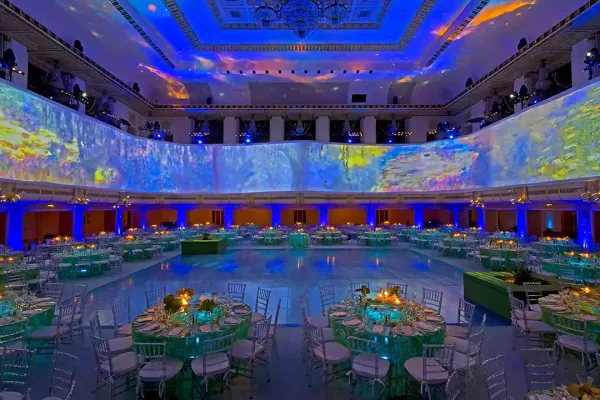
On the technical side, the work begins with a site survey. We measure every surface, note ambient light conditions (a critical factor for outdoor day games), and map the geometry of walls, floors, or domes. For projection mapping, we use multiple high-lumen projectors—often six to twelve for a single large installation—blended together to create a seamless image. The projectors are positioned on truss systems or custom mounts to avoid sightline interference. We then calibrate the mapping software to lock the projection onto the physical surface, compensating for curves, corners, and obstacles like columns or signage.
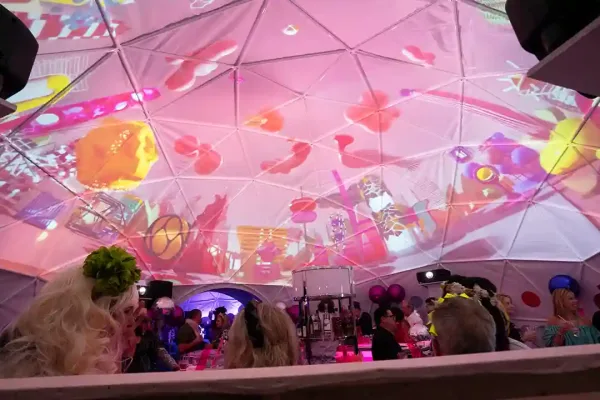
For fan zones that include a dome projection, the setup changes significantly. A 360° dome like the one we built for National Geographic’s “Beneath the Blue” requires a hemispherical screen and a cluster of projectors with fisheye lenses. Inside, fans are surrounded by the action—a full immersion that works especially well for replay highlights, 360-degree player cams, or simulated environments like a stadium flyover. The interactive layer comes from infrared cameras and pressure-sensitive flooring that track movement. When a fan runs, the projected environment shifts accordingly, creating a responsive world that feels alive.
We also handle the entire media server and playback system. Our team builds custom triggers—touch sensors, motion detectors, sound-reactive microphones—that feed into the projection software. For a recent activation, we used a network of cameras to detect the number of people in a zone and adjust the animation density in real time. The result: a floor that filled with virtual confetti when the crowd reached a certain size. This level of event design requires weeks of pre-production, including content creation, projection mapping simulation, and on-site testing.
Practical Planning Notes for Organizers
Space and sightlines are the first consideration. Interactive projection mapping works best in areas with controlled lighting—ideally, low ambient light for maximum contrast. For daytime outdoor fan zones, we use high-brightness projectors (20,000 lumens or more) and matte projection surfaces that reduce glare. The projection area should be at least 20 feet wide for a meaningful interactive experience, with a clear zone of about 15 feet in front of the surface for motion tracking. Avoid placing the projection near direct sunlight or bright overhead lights. If the space has skylights, we recommend scheduling the activation for late afternoon or evening.
Timeline-wise, a typical installation requires four to six weeks from initial brief to event day. The first two weeks are for creative development and content creation—animating the interactive sequences, designing the user interface, and testing the motion-tracking logic. The next two weeks are for hardware procurement and pre-production mapping in our Las Vegas studio. Finally, we arrive on-site three to four days before the event for installation, calibration, and a full dress rehearsal. This timeline holds for both indoor and outdoor setups, though outdoor events may need additional contingency days for weather.
Indoor versus outdoor decisions affect equipment choices. For indoor fan zones, we can use standard projectors and white-painted walls or temporary screens. For outdoor spaces, we use weather-resistant projectors, heavy-duty cabling, and ballasted truss structures. Budgets typically range from $50,000 for a single-wall interactive installation to $250,000 or more for a full dome or multi-surface experience. This includes projectors, media servers, mapping software, content creation, and on-site support. For comparison, the Tropicana facade projection—the world’s largest video game screen—required a seven-figure investment, but most sports fan zone activations fall well below that.
Finally, plan for power and network. Each projector needs a dedicated 20-amp circuit. The media server and tracking system require a stable local network—no Wi-Fi from the venue’s public network; we bring our own router. We also recommend a backup generator for outdoor events. These details are easy to overlook but critical to a flawless execution.
Interactive projection mapping for sporting events and fan zones is not a one-size-fits-all solution. It requires a partner who understands both the creative potential and the technical constraints of live events. At Lumen & Forge, we’ve spent 15 years building these systems for the world’s biggest stages. If you have a fan zone, a halftime show, or a pre-game activation in mind, we’d like to hear about it. Contact us to start the conversation. We’ll help you turn your next sporting event into an experience fans won’t forget.
Frequently asked questions
What makes interactive projection mapping especially effective for sporting events and fan zones?
What surfaces or structures can you project onto in a fan zone?
Can interactive projection mapping incorporate our branding or team logos?
How far in advance should we book interactive projection mapping for a sporting event?
Does interactive projection mapping work outdoors in a fan zone, and how does weather affect it?